What Stress Is Actually Doing to Your Testosterone
I spent years convinced that staying composed under pressure meant I was fine. A crisis leadership stretch running a company through a period with no real playbook, a stint in consulting where the job is managing everyone else's risk, a startup, four kids, a wife who's a physician running her own practice. Plenty of reasons to just push through and call it handled.
I wasn't wrong that I was handling it. I was wrong about what "handling it" was costing me.
You handle pressure well. That's the problem.
Men who perform under sustained stress, the ones running companies, closing deals, managing teams through chaos, tend to believe their composure is proof they're fine. Composure is a behavioral output, not a hormonal one. Those are two entirely different systems, and one of them doesn't care how well you're holding it together on the outside.
THE HPA AXIS: YOUR STRESS RESPONSE SYSTEM
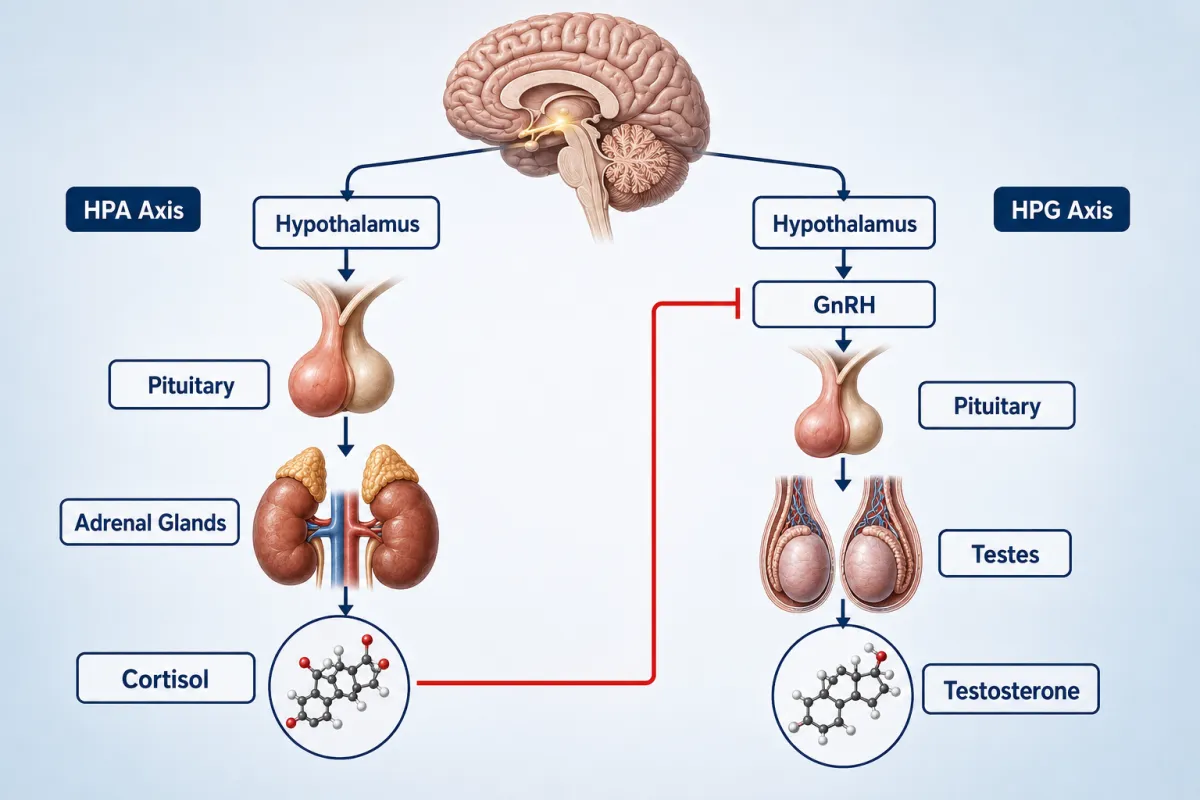
Every stress response in the body runs through what's called the hypothalamic-pituitary-adrenal axis, or HPA axis. When the brain perceives a stressor, real or psychological, the hypothalamus releases corticotropin-releasing hormone (CRH). CRH signals the pituitary gland to release adrenocorticotropic hormone (ACTH), which in turn signals the adrenal glands to release cortisol into the bloodstream.
This system is elegant and adaptive when it works the way it was designed to. Cortisol rises to meet a threat, mobilizes energy, sharpens focus, and then, once the stressor resolves, the system shuts back down and cortisol returns to baseline. The entire mechanism assumes stress is acute and temporary.
Modern professional stress rarely works that way. A demanding quarter doesn't resolve in a day. A high-stakes negotiation doesn't end when the meeting does. Chronic professional and psychological pressure keeps this system activated for weeks, months, sometimes years, which is a fundamentally different physiological event than what the HPA axis evolved to handle.
THE HPG AXIS: YOUR TESTOSTERONE PRODUCTION CHAIN
Testosterone production runs through a parallel system, the hypothalamic-pituitary-gonadal axis, or HPG axis. The hypothalamus releases gonadotropin-releasing hormone (GnRH), which signals the pituitary to release luteinizing hormone (LH), which signals the testes to produce testosterone.
Both systems originate in the hypothalamus and route through the pituitary before reaching their target organs. That shared anatomical real estate is exactly where the collision happens.
WHERE CORTISOL SHUTS DOWN TESTOSTERONE
Chronically elevated cortisol directly suppresses GnRH release from the hypothalamus. Less GnRH means less LH released by the pituitary. Less LH means the testes receive a weaker signal to produce testosterone. The result is a measurable decline in testosterone production, driven not by the testes themselves but by suppressed signaling further up the chain.
This is not a fringe theory. Dr. Robert Sapolsky, professor of biology, neurology, and neurosurgery at Stanford University, built much of his career researching exactly this mechanism, formalized in what's known as the glucocorticoid cascade hypothesis. His decades of work on primates and humans under chronic stress documented that sustained cortisol elevation produces measurable downstream effects across multiple hormonal systems, reproductive function included. In discussing this research publicly, Sapolsky has explained that long-term stress can shut down reproduction by causing erectile dysfunction and disrupting normal hormonal cycles, a finding that applies directly to the HPA-HPG collision described here.
WHY HIGH PERFORMERS ARE THE MOST EXPOSED
The men most at risk are rarely the ones who look stressed. They're the ones who've built entire careers on staying composed under sustained load, the executive who doesn't visibly rattle, the operator who treats pressure as a normal operating condition rather than an emergency.
That composure is precisely the problem. The HPA axis does not distinguish between a man who is falling apart and a man who is performing well while chronically activated. Both keep cortisol elevated. Both suppress GnRH and LH. Both result in reduced testosterone production. External performance and internal hormonal status are two separate readouts, and one gives you no information about the other.
THE SYMPTOM PICTURE NOBODY CONNECTS
This is where things get misattributed. Low libido gets chalked up to being busy or tired. Flat mood and low motivation get written off as normal adult fatigue or a demanding season of life. Poor recovery despite consistent training gets blamed on aging or overtraining syndrome.
All three can trace back to the same root cause: chronic cortisol elevation suppressing testosterone production through the GnRH and LH pathway. None of these symptoms announce themselves as a hormonal issue. They present as vague, generalized decline, which is exactly why they get missed or explained away.
A man can be training hard, eating a clean diet, and sleeping a reasonable number of hours, and still be running a suppressed hormonal baseline, because none of those inputs directly counteract chronic HPA axis activation. Lifestyle optimization on the visible side does not guarantee hormonal optimization on the biochemical side.
WHAT CHANGED FOR ME
I didn't fix this by getting better at composure. That was never the problem. What actually changed things was treating stress management as a discipline instead of a personality trait, something with real inputs instead of something you just absorb and move past. Sleep became non-negotiable rather than the first thing sacrificed. Recovery got built into the week deliberately instead of squeezed into whatever time was left. And eventually, I checked the actual numbers instead of assuming that effort and output equaled hormonal health.
That last part is the one most guys skip, because it means admitting you might not actually know what's happening under the surface.
WHY YOU CANNOT ESTIMATE THIS
The natural instinct is to assume that feeling reasonably functional means hormone levels are reasonably fine. That assumption doesn't hold up against the physiology. A man under chronic stress can feel entirely capable while his testosterone, free testosterone, and LH are all sitting at suppressed levels that only show up on bloodwork.
This is why guessing doesn't work here. The only way to know what sustained stress has actually done to your hormonal baseline is to test it directly, testosterone, free testosterone with SHBG, and the broader metabolic and hormonal picture that shows whether your system is compensating or genuinely compromised.
WHERE TO START
This isn't about assuming stress is the singular cause and stopping there. It's about establishing a real, current baseline so you're working from data instead of inference. Composure under pressure is a valuable professional skill. It is not a substitute for knowing your actual numbers.
The $100 consult is where that baseline conversation starts, a full review of what your hormonal picture actually looks like, not an assumption based on how well you're performing.
Source & Expert Reference
This article references the work of Dr. Robert Sapolsky, Professor of Biology, Neurology, and Neurosurgery at Stanford University and a leading researcher in the biology of stress. Dr. Sapolsky is known for his work related to the glucocorticoid cascade hypothesis and the physiological effects of chronic stress.
Springhouse Men's Wellness is a physician-founded practice led by Dr. Melissa Lee-Agawa, delivered in partnership with Grace & Glow MD. These articles are written by Taka Agawa, founder, with Dr. Lee-Agawa's clinical guidance throughout. Spring House, Pennsylvania. www.springhousemen.com