The Protein Obsession Is Missing the Point
Why muscle growth after 35 is a hormonal question, not a macro question.
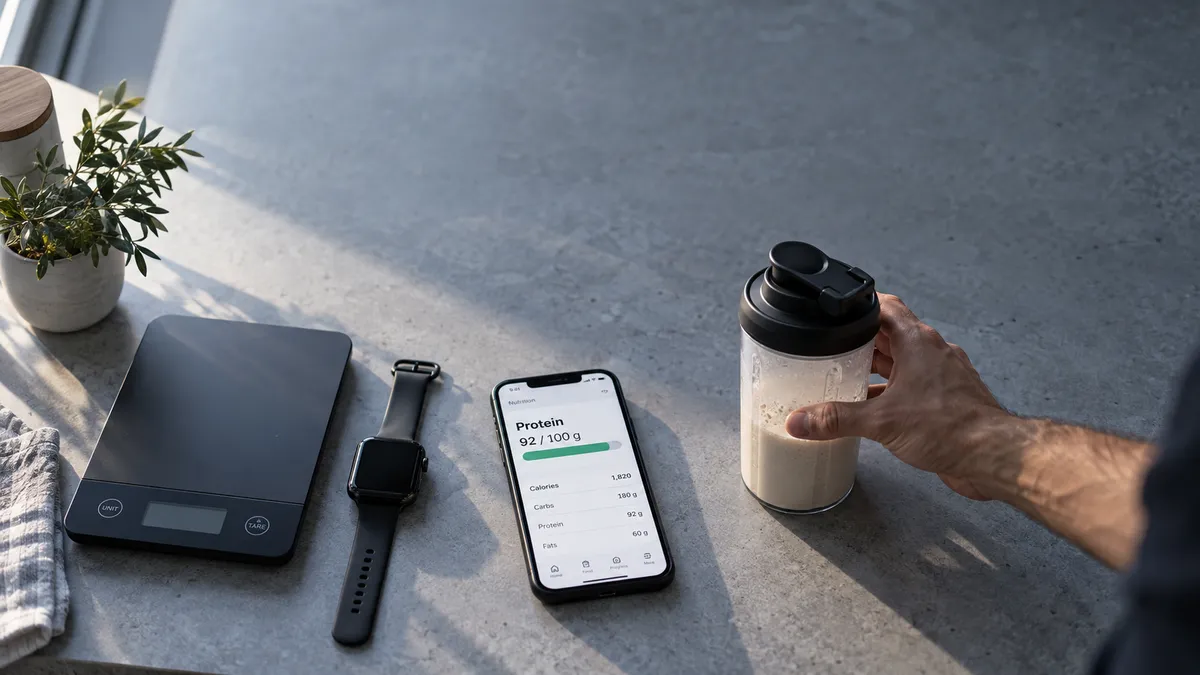
Protein is the most tracked number in men's fitness right now. Apps log it to the gram. Coffee chains have added protein milk and protein foam. Grocery shelves carry high-protein versions of cereal, pasta, chips, and frozen yogurt. In January 2026, the updated Dietary Guidelines for Americans raised the recommended protein intake from 0.8 grams per kilogram of body weight to between 1.2 and 1.6 grams, and urged Americans to prioritize protein at every meal.
For men who train, the message landed as permission to push higher. Another scoop. Another chicken breast. Another protein bar on the drive home.
Yet a large number of men in their late 30s and 40s describe the same frustrating pattern. They train consistently. They hit their protein target. They sleep reasonably well. And their muscle mass holds steady at best, while the effort required to maintain it keeps climbing.
The instinct is to adjust the macro again. The evidence points somewhere else. Protein is the raw material for muscle, but whether that material gets used depends on a hormonal signal. When that signal weakens, more protein is more effort with a ceiling.
HOW MUSCLE IS ACTUALLY BUILT
Muscle protein synthesis (MPS) is the process of assembling amino acids from your diet into new muscle proteins. Three inputs drive it:
Mechanical load. Resistance training damages and stresses muscle fibers, creating the demand for new protein.
Amino acid supply. Dietary protein, especially leucine-rich sources, provides the building material and triggers the mTOR pathway that switches synthesis on.
Hormonal signaling. Anabolic hormones regulate how strongly and how long muscle responds to the first two inputs. The two that matter most for men are testosterone and insulin-like growth factor 1 (IGF-1).
Most men optimize the first two with real discipline. Very few have ever looked at the third.
TESTOSTERONE: THE EVIDENCE FROM SUPPRESSION TRIALS
The best way to test whether a hormone matters is to remove it and hold everything else constant. Two randomized trials have done exactly that with testosterone.
In 2006, Danish researchers published a randomized, placebo-controlled, double-blinded study in the American Journal of Physiology: Endocrinology and Metabolism. Twenty-two healthy young men were split into two groups for 12 weeks. Half received a GnRH analog that suppressed their testosterone to a small fraction of normal; half received placebo. Starting at week 4, both groups completed the same 8-week strength program. The placebo group increased isometric knee extension strength by about 10 percent. The suppressed group showed no strength change at all. Leg lean mass increased less in the suppressed group, and body fat went up in the suppressed group while it went down in the placebo group. The authors concluded that endogenous testosterone is of paramount importance to the adaptation to strength training.
In 2022, a UK team published a follow-up trial in the Journal of Cachexia, Sarcopenia and Muscle using the same approach over six weeks of supervised whole-body training, with muscle biopsies to look inside the process. Suppressing testosterone blunted gains in fat-free mass and muscle thickness and reduced the molecular signals that drive muscle growth. Their conclusion was direct: adequate testosterone has a central role in training-induced muscle growth that mechanical loading alone cannot overcome.
This area of research has real nuance. Several studies have found that the short-lived rise in testosterone after a workout does not predict how much muscle a man gains. That finding is often misread as "testosterone doesn't matter for muscle." The suppression trials answer a different and more useful question. They show that baseline sufficiency matters. When the foundation is low, the same training and the same diet produce less.
IGF-1: THE SECOND HALF OF THE SIGNAL
IGF-1 is produced mainly by the liver in response to growth hormone (GH). It binds receptors on muscle cells and activates pathways that increase protein synthesis and support tissue repair. Dietary protein supports IGF-1 production, but it cannot replace the upstream growth hormone signal.
That signal declines steadily through adulthood. Published research estimates that GH secretion falls by roughly 14 percent per decade after early adulthood, with IGF-1 declining alongside it at roughly 10 percent per decade. The two hormone systems are also linked. Falling sex hormone levels are one of the recognized contributors to the age-related drop in growth hormone, which means a decline in testosterone can pull the GH and IGF-1 axis down with it.
Growth hormone is released largely during deep sleep, which is why sleep belongs in this conversation. We covered that mechanism in "What Your Sleep Is Actually Doing to Your Hormones."
WHY THE PLATEAU ARRIVES IN YOUR LATE 30s AND 40s
Three changes converge in this window, and none of them can be fixed by adjusting a macro.
1. Available testosterone falls faster than total testosterone.
The Massachusetts Male Aging Study, a population-based cohort of men aged 40 to 70, followed participants for seven to ten years. Within individual men, total testosterone declined about 1.6 percent per year. Bioavailable testosterone, the portion tissue can actually use, declined 2 to 3 percent per year. SHBG, the binding protein that holds testosterone out of circulation, rose over the same period. A man can carry a total testosterone number that looks unremarkable while the testosterone available to his muscle is falling year over year.
2. Muscle becomes less responsive to protein.
Researchers at McMaster University analyzed how much protein young and older men needed in a single meal to maximize muscle protein synthesis. Young men (around 22) reached their maximum at roughly 0.24 grams per kilogram of body weight. Older men (around 71) needed roughly 0.40 grams per kilogram. This phenomenon is called anabolic resistance. The study captures the end of the trajectory, not men in their 40s specifically, but the shift is gradual and the direction is clear.
3. The protein ceiling is already in place.
In 2018, the British Journal of Sports Medicine published the largest systematic review and meta-analysis to date on protein supplementation and resistance training. Protein supplementation did improve gains in strength and muscle size. But the benefit plateaued at a total intake of about 1.6 grams per kilogram per day. Beyond that point, additional protein produced no further gains in lean mass. The analysis also found that the added benefit of protein became smaller with increasing age.
Put those three findings together and the picture is clear. The man who is already eating around 1.6 g/kg, training consistently, and still not progressing is not short on protein. He has reached the limit of what that input can do, at the same time his hormonal signal is weakening and his muscle is becoming harder to stimulate.
This connects to a pattern we covered in "What Body Composition Is Telling You About Your Hormones": when effort stops producing the results it used to, the explanation is usually information you do not have yet, not discipline you are lacking.
WHAT THE PROTEIN TREND GETS RIGHT
None of this is an argument against protein. Adequate protein is necessary for building and keeping muscle, and the evidence that most active men benefit from more than the old 0.8 g/kg baseline is solid. The practical guidance holds up:
Reach your daily target, generally within the 1.2 to 1.6 g/kg range the new guidelines describe.
Distribute protein across meals rather than loading it into dinner, since each meal is its own opportunity to stimulate synthesis.
Keep training. Resistance exercise is the strongest tool for making muscle more responsive to protein at any age.
The mistake is assuming that protein is the only lever, and that the answer to a plateau is always more of it.
THE MISSING VARIABLE: WHAT BLOODWORK SHOWS
A single total testosterone test does not tell you whether your hormonal foundation is supporting your training. The number needs context. A comprehensive panel answers the questions a single marker cannot:
Free and total testosterone with SHBG. Shows not just how much testosterone you produce, but how much is actually available to tissue.
Estradiol (LCMS). Testosterone converts to estradiol, and the balance between the two affects body composition, mood, and drive.
FSH and LH. The pituitary signals that tell the testes to produce testosterone. They show whether a low number is a production problem or a signaling problem.
TSH. An underactive thyroid slows metabolism and protein turnover and can create the same plateau that gets blamed on diet.
Hemoglobin A1C. Insulin sensitivity influences how well muscle responds to the protein you eat.
The Springhouse Men's Panel includes each of these, along with Prolactin, PSA Total, a CBC, a CMP, and a Lipid Panel. Together they show whether the system your training depends on is working, and where it is not.
FROM TRACKING TO KNOWING

Men who train seriously tend to measure everything they can control. Sets, reps, macros, sleep, heart rate variability. Hormones are the one system most of them have never measured, even though it sets the ceiling on everything else.
If you are already hitting your protein target and the progress has stopped, the next adjustment is not on your food log. It is a baseline you have never seen.
Springhouse begins with a $100 consultation with Dr. Lee-Agawa, applied toward services, and bloodwork that shows exactly what your training is working with.
Sources
U.S. Department of Agriculture and U.S. Department of Health and Human Services. Dietary Guidelines for Americans, 2025 to 2030. January 2026.
Kvorning T, Andersen M, Brixen K, Madsen K. Suppression of endogenous testosterone production attenuates the response to strength training: a randomized, placebo-controlled, and blinded intervention study. Am J Physiol Endocrinol Metab. 2006;291(6):E1325-E1332.
Gharahdaghi N, et al. Pharmacological hypogonadism impairs molecular transducers of exercise-induced muscle growth in humans. J Cachexia Sarcopenia Muscle. 2022;13(2):1134-1150.
Feldman HA, et al. Age trends in the level of serum testosterone and other hormones in middle-aged men: longitudinal results from the Massachusetts Male Aging Study. J Clin Endocrinol Metab. 2002;87(2):589-598.
Moore DR, et al. Protein ingestion to stimulate myofibrillar protein synthesis requires greater relative protein intakes in healthy older versus younger men. J Gerontol A Biol Sci Med Sci. 2015;70(1):57-62.
Morton RW, et al. A systematic review, meta-analysis and meta-regression of the effect of protein supplementation on resistance training-induced gains in muscle mass and strength in healthy adults. Br J Sports Med. 2018;52(6):376-384.
Sellami M, Dhahbi W, Hayes LD, et al. Combined sprint and resistance training abrogates age differences in somatotropic hormones. PLoS ONE. 2017;12(8):e0183184.
Springhouse Men's Wellness is a physician-founded practice led by Dr. Melissa Lee-Agawa, delivered in partnership with Grace & Glow MD. These articles are written by Taka Agawa, founder, with Dr. Lee-Agawa's clinical guidance throughout. Spring House, Pennsylvania. www.springhousemen.com