The Cardiovascular–Sexual Health Connection Nobody Explains
If you've ever wondered whether erectile function and heart health are related, the honest answer is that they are not related. They are the same system, observed from two different angles. This is one of the more well established findings in vascular medicine, and one of the least understood by the men it applies to.
TWO CONVERSATIONS, ONE MECHANISM
Most men keep sexual health and cardiovascular health in separate mental folders. One belongs to a urologist or gets handled quietly, if at all. The other belongs to a cardiologist, and usually doesn't get addressed until there's already a diagnosis attached to it.
This separation doesn't reflect the underlying biology. Both systems depend on the same tissue: the endothelium, a single-cell-thick lining inside every blood vessel in the body, from the coronary arteries to the microvasculature of the penis.
Healthy endothelium does one job extremely well. It produces nitric oxide, a molecule that signals the smooth muscle in vessel walls to relax. That relaxation is what allows increased blood flow, whether that flow is going to the heart during exertion or to the penis during arousal. It is the same molecular signal, operating on the same cell type, in different locations.
When the endothelium is damaged, through chronic elevated blood sugar, high LDL cholesterol, elevated blood pressure, smoking, or the general metabolic wear of aging without intervention, nitric oxide production drops. Vessels lose their ability to relax and dilate on demand. This is called endothelial dysfunction, and it is not localized. It happens throughout the vascular system simultaneously, even though its effects become visible in different places at different times.
THE ARTERY SIZE HYPOTHESIS
Here is the detail that explains why sexual function often changes before a man has any cardiac symptoms at all.
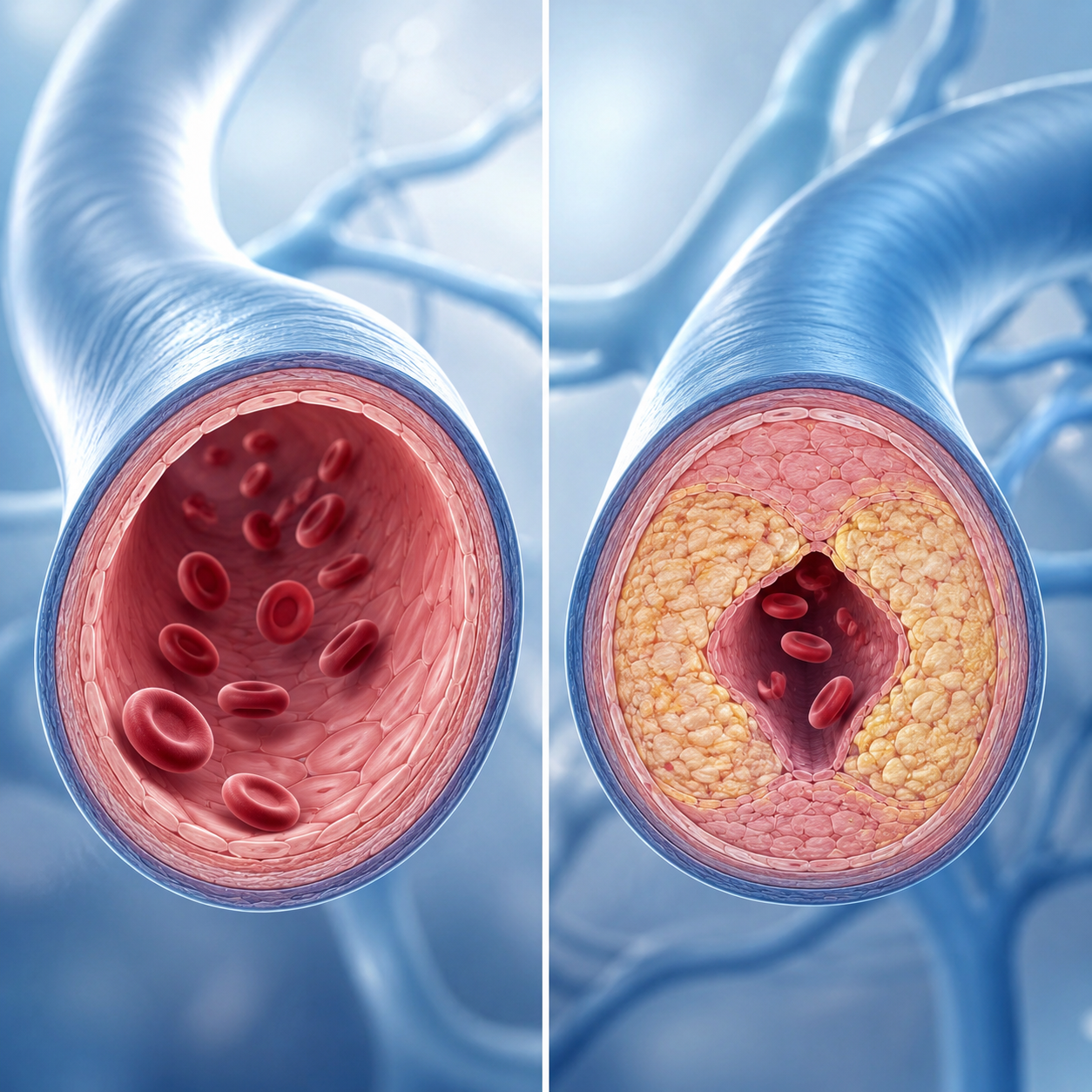
The arteries supplying the penis are considerably smaller than the coronary arteries supplying the heart, roughly 1 to 2 millimeters in diameter compared to 3 to 4 millimeters. When atherosclerotic plaque begins to accumulate and narrow blood vessels throughout the body, it narrows the smallest vessels first, because there is proportionally less room before flow becomes clinically restricted.
This is sometimes called the artery size hypothesis, and it is the leading explanation for why erectile dysfunction so frequently precedes a cardiac diagnosis rather than following one. The same plaque burden that will eventually compromise coronary flow is often measurable in penile vascular function years earlier.
The research supports this pattern consistently. A large umbrella review pooling multiple systematic reviews and meta-analyses found that men with erectile dysfunction carry a 45 percent higher relative risk of cardiovascular disease, a 50 percent higher risk of coronary heart disease, a 50 percent higher risk of cardiovascular related mortality, a 25 percent higher risk of all-cause mortality, a 55 percent higher risk of myocardial infarction, and a 36 percent higher risk of stroke, compared to men without erectile dysfunction. Separately, the MESA study, a multi-site prospective cohort published in the American Heart Association's journal Circulation, found that men with subclinical vascular disease demonstrated measurable erectile dysfunction before their coronary heart disease became clinically apparent.
The clinical implication is direct. A change in erectile function is not just a quality of life issue. It is frequently the first available signal of a vascular process that will eventually affect the heart if left unaddressed.
WHAT THIS MEANS FOR HOW YOU READ YOUR OWN BLOODWORK
This is the reasoning behind how the Springhouse Men's Panel is constructed. It would be easy to build a panel focused entirely on testosterone, since that's the number most men expect to see. That approach misses the majority of what's actually driving how a man feels and performs.
The panel includes a full lipid panel, hemoglobin A1C, and a comprehensive metabolic panel alongside testosterone, free testosterone with SHBG, estradiol, FSH, LH, prolactin, PSA, CBC, and TSH. The lipid and metabolic markers are not filler. They are the most direct, earliest readable indicators of endothelial and vascular health available through standard bloodwork, and vascular health is the shared mechanism behind both cardiovascular risk and sexual function.

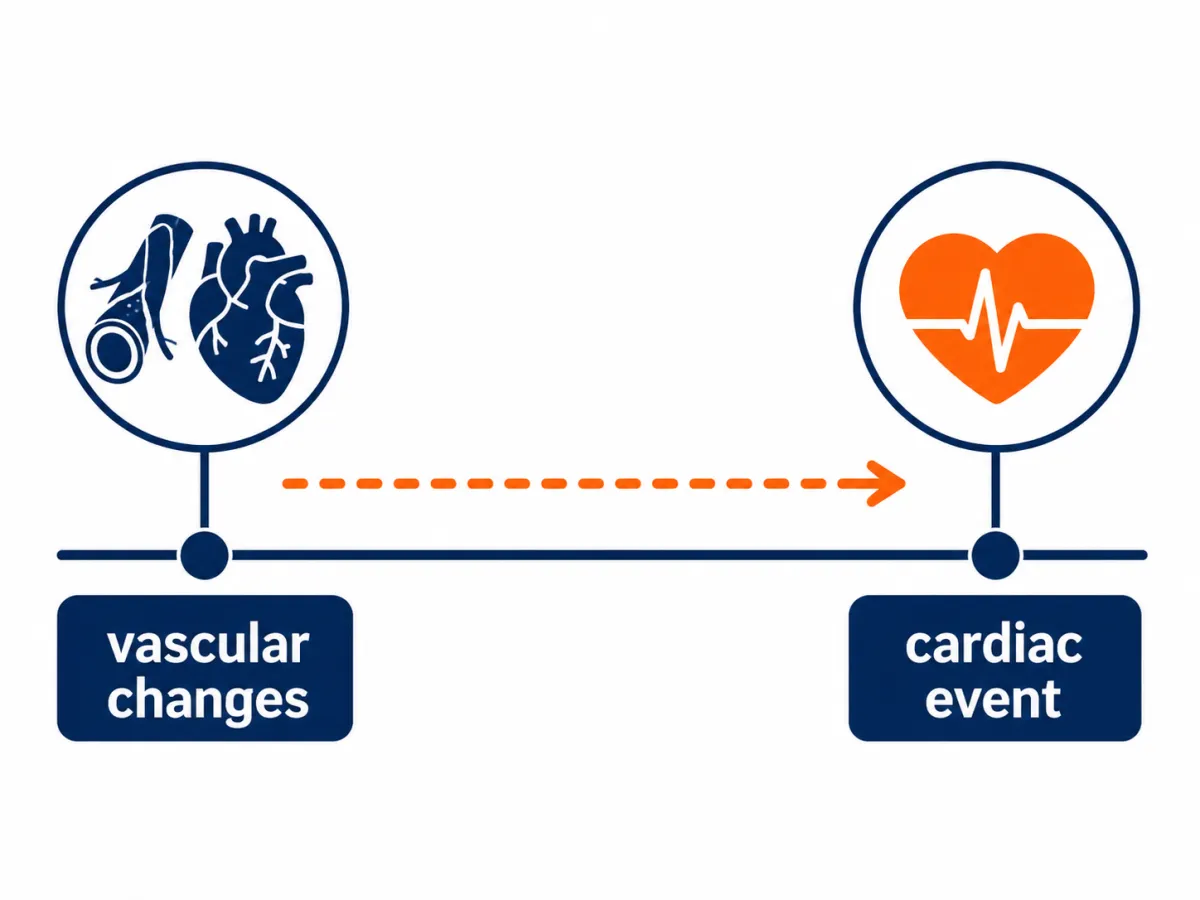
An LDL that's trending upward, an A1C moving out of optimal range, or blood pressure creeping higher at each visit are not abstract numbers to file away. They are predictive of vascular changes that show up in sexual function first and cardiac events later. A man can have completely normal testosterone and still be sitting on a metabolic and vascular profile that predicts real future risk. Testing hormones alone would miss this entirely.
This is why we frame the panel as cardiovascular intelligence, not simply hormone intelligence. It tells you where your vascular system stands today, using data most annual physicals don't connect to this specific mechanism.
WHERE THIS CONNECTS TO TREATMENT
Understanding endothelial dysfunction as the root mechanism also clarifies why certain treatment approaches work differently than others. Therapies built around angiogenesis, the formation of new blood vessels, and active endothelial repair are addressing the tissue-level process itself rather than managing a downstream symptom. This is the mechanism behind Apex RF treatment, which we've detailed in a separate piece focused specifically on the technology.
The distinction matters clinically. A treatment that improves vascular tissue quality is working on the same system responsible for both cardiac risk and sexual function. A treatment that only addresses symptoms in the moment is not changing that underlying trajectory.
None of this is a substitute for cardiology care. If you have a known cardiac diagnosis, established risk factors, or a family history that puts you in a higher risk category, that relationship with your cardiologist remains the primary one. What a comprehensive panel offers is an earlier, complementary data source, one that most primary care visits are not structured to connect to this specific pathway.
WHY THIS MATTERS NOW
Men who take a data driven approach to training, sleep, recovery, and business decisions often have no equivalent framework for their own vascular health. It gets treated as an afterthought, checked once a year in a format that doesn't explain what the numbers mean or how they connect to anything else.
Sexual function is not a separate category from cardiovascular health. It is one of the earliest, most honest indicators available, and it's reading out information most men never learn to interpret.
A comprehensive panel that includes lipids, A1C, and metabolic markers alongside hormone testing gives you the complete picture rather than half of one. Understanding what those numbers mean, together, changes what you do next.
The $100 consult includes a full walkthrough of your results and what they indicate about your vascular health specifically, not just whether each number falls within a standard reference range.
Springhouse Men's Wellness is a physician-founded practice led by Dr. Melissa Lee-Agawa, delivered in partnership with Grace & Glow MD. These articles are written by Taka Agawa, founder, with Dr. Lee-Agawa's clinical guidance throughout. Spring House, Pennsylvania. www.springhousemen.com